
Benchmark indices Sensex and Nifty settled with gains for the third straight session on Monday, helped by buying in auto, banking and capital goods shares despite a spike in crude oil prices. The 30-share BSE Sensex rose 114.92 points or 0.19 per cent to close at 59,106.44 points with 22 of its components ending in the green and eight closing lower. It moved in a range of 58,793.08 points to 59,204.82 points during intra-day trade.

Reflecting a loss of "growth momentum", manufacturing activities in the country slowed down to a six-month low in March amid softer increases in new orders, production and employment, according to a survey.

The faster-than-expected rise in interest rates by the US Federal Reserve (US Fed) shook global financial markets in early 2022. And now the ongoing war between Russia and Ukraine has lifted commodity prices, with Brent crude oil hitting a 14-year high of $139 a barrel in intraday trade. All these developments have sent the equity markets across the world into a tailspin.

A reading above 50 represents expansion while one below means contraction.

According to Japanese financial services major Nomura, India's manufacturing PMI remained in the expansion zone but suggested some consolidation after the rapid ramp up of activity in December.

Firms seem to have adopted a wait-and-see approach on their plans until public policies become clearer upon the formation of a government.

A reading above 50 indicates expansion while a one below this level means contraction.

The 50-issue NSE Nifty too cracked below the 10,400-mark and hit a low of 10,323.90 before finishing 99.50 points, or 0.95 per cent down at 10,358.85.

Service providers' confidence with regard to the 12-month outlook for business activity remained positive.

This is the 22nd consecutive month that the manufacturing PMI has remained above the 50-point mark.

In the Sensex pack, Tata Motors was the biggest loser, shedding 3.29 per cent, followed by ICICI Bank, IndusInd Bank, Infosys, HCL Tech, Axis Bank, TCS, HUL, Asian Paints, Sun Pharma, SBI, Tata Steel and NTPC, which dropped up to 3.23 per cent.

The Nikkei India Manufacturing Purchasing Managers Index (PMI), fell from 52.1 in February to a five-month low of 51.0 in March, indicating the slowest improvement in operating conditions recorded by the survey since last October.

On the price front, Indian manufacturing companies continued to face higher input costs during August.

The BSE 30-share index after a positive opening stretched to 31,772.41, but could not stay there for long buffeted by the selling pressure. It hit a low of 31,562.25 before settling lower by 79.68 points, or 0.25 per cent, at 31,592.03.
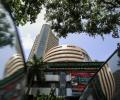
The NSE Nifty, however, ended a shade higher by 6.65 points or 0.06 per cent at 10,442.20

Benchmark Sensex trimmed early gains to close marginally higher while Nifty settled flat in choppy trade on Tuesday as gains in auto shares were offset by selling pressure in banking and energy shares. The 30-share BSE barometer closed marginally up by 37.08 points or 0.06 per cent to 60,978.75 with 15 of its stocks ending in green and the rest in red. The index opened higher and gained over 300 points to a high of 61,266.06 in early trade.

Equity benchmarks Sensex and Nifty on Friday spurted by nearly 2 per cent, propelled by heavy buying in IT, metal and financial stocks amid a rally in global markets after lower-than-expected US inflation data. A strong rupee against the US dollar and unabated foreign capital inflows further bolstered sentiment, traders said. Easing US inflation triggered speculation that the US Federal Reserve might slow down the pace of interest rate hikes.

This is the 14th consecutive month that the manufacturing PMI remained above the 50-point mark. In PMI parlance, a print above 50 means expansion, while a score below that denotes contraction.

Nomura Group Study found that in 2019, out of the fifty-six companies which shifted their production out of China, only three of these invested in India; while 26 went to Vietnam, 11 to Taiwan, and 08 to Thailand. In April 2020, Nikkei noted that out of the 1,000 firms which were planning to leave China and invest in Asian countries, only 300 of them were seriously thinking of investing in India.
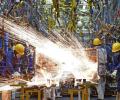
This is the ninth consecutive month that the manufacturing PMI remained above the 50-point-mark.

India's electric mobility goal, which has so far been riding on two wheels, is all set to graduate to four wheels. At least, the journey has begun. Hyundai Motor India said it would invest Rs 4,000 crore till 2028 to launch half-a-dozen electric vehicles (EVs) in India. It would eventually straddle premium and mass segments. The first of these - the electrified version of an internal combustion engine (ICE)-powered model - will go on sale as early as next year.

IndusInd Bank was the top gainer in the Sensex pack, spurting over 5 per cent, followed by Bajaj Finserv, HCL Tech, Bajaj Finance, Kotak Bank and Axis Bank. NSE Nifty jumped 203.15 points to 17,780.00.

Losses largely came from the metal index, followed by power, infrastructure, realty, PSU, oil and gas, capital goods, FMCG, healthcare, auto and banking.
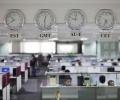
Manufacturing production growth eased in May, which combined with the slowdown in services resulted in a weaker increase in private sector output, the survey said.

The biggest losers in the Sensex pack were Vedanta, Tata Steel, M&M, Tata Motors, Maruti, Hero MotoCorp, PowerGrid, Bharti Airtel, SBI and Coal India -- falling up to 4.48 per cent.

The NSE Nifty gained 77.85 points, or 0.71 per cent, to finish at 11,008.30. Intra-day, it shuttled between 10,821.55 and 11,035.65.

'Advancing friendship with Japan. Prime Ministers @narendramodi and @kishida230 held productive talks in New Delhi. Both leaders discussed ways to boost economic and cultural linkages between the two countries,' Modi's office tweeted.

The Nikkei India Manufacturing Purchasing Managers' Index (PMI) stood at 47.9 in July, down from 50.9 in June, its lowest mark since February 2009, and highlighted the first deterioration in business conditions in 2017 so far.

Bajaj Finance was the top gainer in the Sensex pack, rising around 5 per cent, followed by IndusInd Bank, Tata Steel, ITC, Bajaj Finserv, Tech Mahindra and Infosys. On the other hand, Maruti, Bajaj Auto, Nestle India, PowerGrid and Axis Bank were among the laggards.

The breadth, indicating strength of the market was strong

The upcoming corporate results season and the approaching Union Budget kept investors on their toes
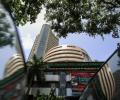
Market sentiment suffered a jolt after other Asian markets closed with widespread losses and European markets dropped in early trade

On the other hand, jobs increased for the 10th straight month in the manufacturing sector, albeit only slightly
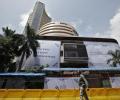
Investors went looking for bargain in banking, oil and gas and auto stocks.

The broader NSE Nifty rose nearly 124 points to settle just below the psychological 11,000 level.

It was the second straight week of gains for the benchmarks.

The Sensex has now lost 878.32 points in six sessions -- its longest string of losses in six months.

Out of 30 Sensex shares, 19 ended lower while 11 gained

The Nikkei India Manufacturing PMI dipped from 50.3 in November to 49.1 in December.

Japanese auto giant Suzuki Motor Corporation on Tuesday said it plans to make India an export hub for its small cars, mainly for European and African markets.
 © 2026 Rediff.com - Advertise with us - Disclaimer - Privacy Policy - Sitemap - Feedback - About us - Terms of use - Grievances